

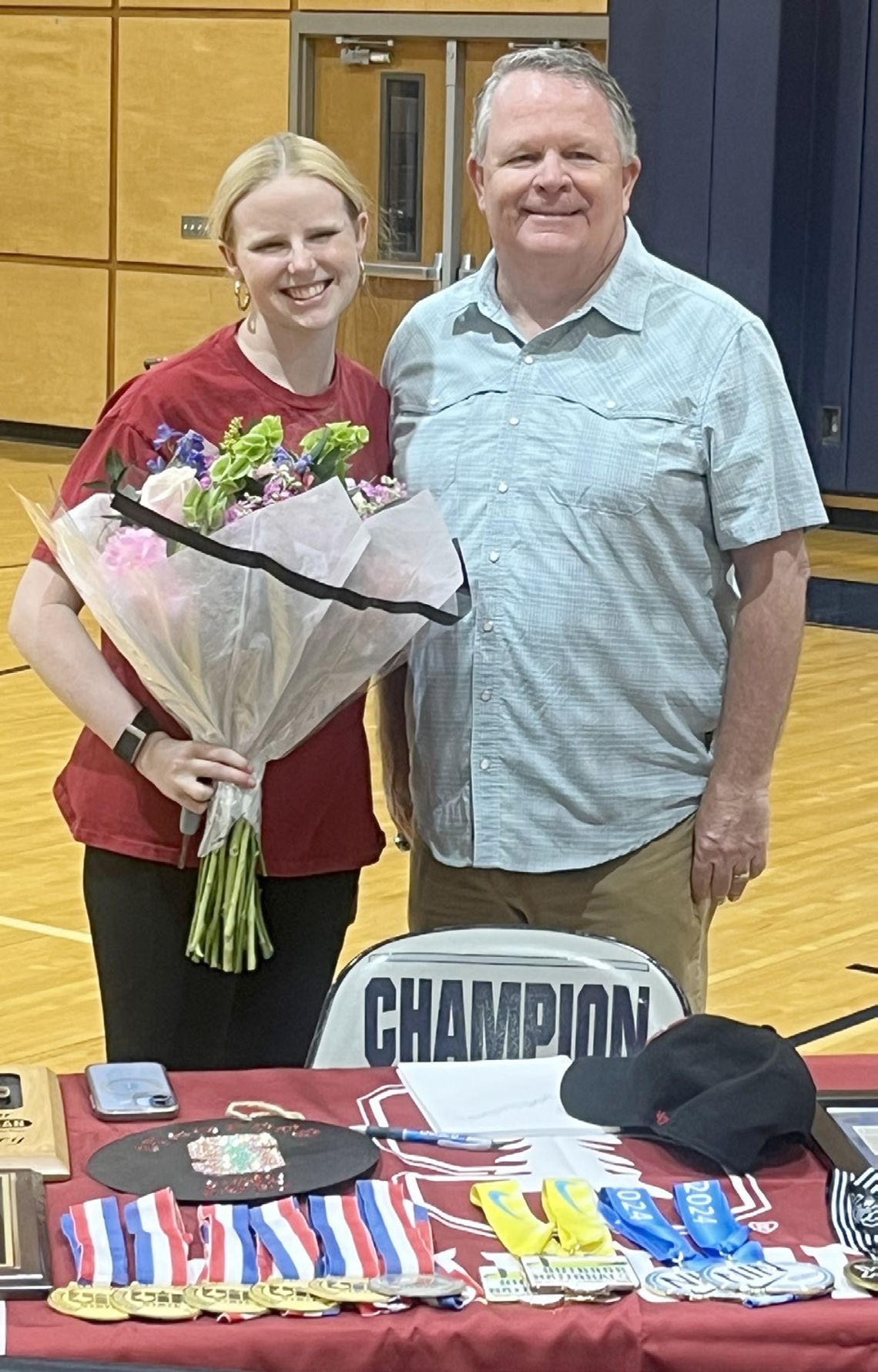
It’s been quite a journey for recent Boerne Champion graduate Elizabeth Leachman over the past 18 months or so.
After winning the Foot Locker Cross-Country Championship in December 2024 during her junior year, her life took an unexpected turn.
Around that time, the running phenom’s biggest battles were away from the track/course as she faced some health issues that caused her heart rate to spike and forced her to stop running in the middle of at least two different races.
After a series of doctor visits and various tests trying to find answers, Leachman finally ended up at the Mayo Clinic in Minnesota where she was diagnosed with postural orthostatic tachycardia syndrome, also known as POTS.
According to the Mayo Clinic’s website, “POTS affects the autonomic nervous system, which controls involuntary body functions such as heart rate and blood pressure.”
In Leachman’s case, POTS caused her heart rate to spike to more than 200 beats a minute when running.
Leachman decided to tell her story and spoke with Runner’s World magazine writer Cory Mull in an article that was posted last January. Leachman said she was happy with how the story was written.
“We talked about making sure we delivered it in a good way, but I was okay with having it out there,” she said. “Overall, I think a lot of love has come out of it.”
Leachman told the Boerne Star that it was time to go public with her health issues in hopes of helping others.
“It’s good to spread awareness for things going on to try to get more resources for people who might be in a similar situation,” she said. “I wanted other girls out there to realize that they aren’t alone, and other people are going through it. It does affect a lot of teenage girls especially, and they need to realize they aren’t alone. Hopefully one of these days there will be more resources and funding, and those people will be better understood by their peers.”
The Mayo Clinic’s website states that “teenagers - the group most often affected by POTS – usually outgrow the disorder by the time they reach their 20s.”
Treatment usually involves diet, exercise and medications, and Leachman said meds help but aren’t a panacea.
“They manage some of the symptoms, but it isn’t a great fix for any of it,” she said.
Cause for hope
Because there is a chance for Leachman to outgrow the disorder, she’s hoping to run again competitively and recently signed with Stanford University where she will major in economics and political science.
Even though she hasn’t raced competitively since December 2024, Stanford has reserved a spot for her on their cross country/track teams in hopes it might happen again.
“If I got back to a place where I’m competitive on the national level, not necessarily winning races, then they would give me a full ride,” she said. “They have saved a spot for me on the team, and I appreciate it, but I wouldn’t be on an athletic scholarship until I’m competing at least. As soon as possible would be great because Stanford is not cheap.”
Leachman signed with the Cardinal in April at a ceremony in Charger Gym and admits it’s a slow process as she tries to get back into competitive form.
“It’s not going great to be honest; it’ll probably be a while before I compete again. I am back to fully working out and I can cross train with mostly no problems, so it’s a big step from where I was last October,” she said.
As a point of reference, Leachman posted a 15:25 in a 5K race in 2024, which set a girls national high school outdoor record at the time. She said if she were to run a 5K today, she wouldn’t be near that time.
“I think if I raced a 5K on the track right now the best I could do would be right under 19 minutes, so not super close,” she said.
A silver lining
Leachman admits that not being able to race has been frustrating but adds that she is dealing better with it now than she was at the beginning.
“It’s been incredibly frustrating, last year I think it was a lot harder on me because it was new to me and for a long time, so unknown. Seeing other people go out there and race was hard for me, but something that helped was that people who I admire, we’re supportive of me during that time,” she said. “I think over the last year I’ve learned to find value outside of the running world, and as much as I miss it and hope to go back one day, I’ve learned a lot about myself and learned other ways to find a sense of self-worth.”
Leachman said she’s doing all she can in hopes of returning to top form and added that she will put the rest in God’s hands.
“Ultimately, I’ve come to realize that it’s not in my control and I’m going to have to trust in God’s plan for me,” she said. “I’m doing everything in my power to get there, but I’m going to have to be patient and pray and hope things work themselves out in a good time frame.”



Comment
Comments