

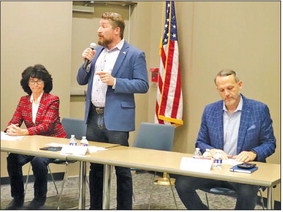
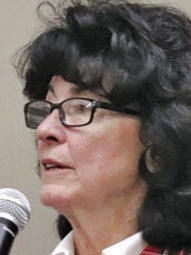
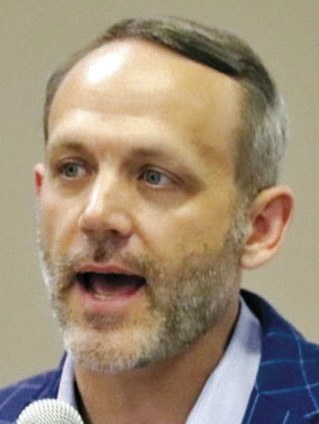
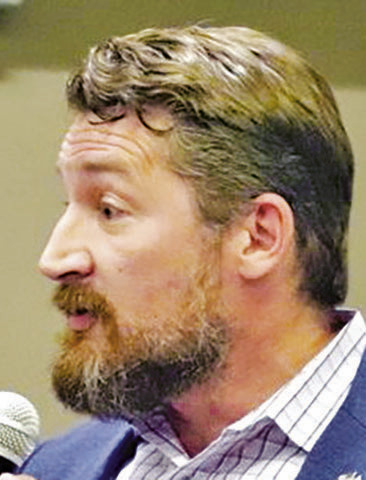
Three GOP candidates for Kendall County judge shared their visions for water conservation and roadway fixes to a packed house Wednesday, explaining why they are qualified to sit on Commissioners Court. The overflow crowd in the Patrick Heath Public Library heard incumbent Shane Stolarczyk and challengers Ricky Gleason and Besa Martin answer seven questions offered by the Boerne Civic Roundtable.
The Republicans will face each other in the March 3 party primary. So far, no Democrats have announced for the office. The general election is Nov. 2.
In this edition, the Star is focusing on the candidates’ responses to the issues of sustainable water sources, and mobility and road priorities.
Sustainable water
Stolarczyk, elected in 2023, said a combination of new technology and prioritizing water catchment systems could keep the county moving forward.
He told of a trip to Kerrville where he learned of aquifer and storage recovery, or ASR, where extra wastewater or reserve water is injected back into the aquifer.
Kerrville and San Antonio are seeing positive results from this technology.
“This is promising for Kendall County. During these big rainstorms and rain events, where we have a lot of water, you would use those events to recharge your aquifer, to draw down when we have our droughts,” he said.
He said the county also continues to encourage catching and storing rainwater.
Martin, a rancher and attorney who moved to the Boerne area 20 years ago, said the county can benefit from the state’s recent focus on water issues.
The Legislature this session passed House Bill 500, which allocates more than $1 billion to spend on water sources and projects.
“Counties such as Kendall County can put in for grants to get planning, acquisition, design and construction,” Martin said. “We have the ability to apply for producing grants and upgrading our water system.”
She would like to see the establishment of a proactive group at the county level to focus on water issues and led by the county judge.
Gleason, a partner and financial advisor at Prime Capital Financial, said collaboration is key to getting out in front of water needs.
“We’ve got to make sure we are securing water for our people that are here now, and not just those people who are coming in,” he said, noting the rise of area housing developments.
He said long-term goals need to be planned out with experts, the groundwater districts, the cities and its neighbors.
He praised the idea of water-catchment systems: “It’s like having your own little aquifer on your own property.”
He added the county also must be respectful of its landowners and their property rights, “but it definitely all starts with the county developing that long-term plan.”
Mobility and road priorities
Gleason said the county needs to determine where to build arterial growth to handle increasing Boerne and Kendall County traffic.
“It’s not about building mega-projects and structures, it’s more about figuring out creative ways to move people around our county,” Gleason said, rather than simply “widening all the state highways and creating more bottlenecks.”
He alluded to Transportation Committee work he said needs an update.
In addition, safety and security become a traffic issue when Boerne Champion High School begins and ends its day.
“God forbid you have a heart attack when school’s getting out. I don’t know if you yourself or emergency services can get to a place where you could be safe,” he said of the Herff-River Road bottleneck.
Collaboration with state resources and funding, as well as schools, could help address such mobility quagmires.
Martin said population growth fuels many of the transportation issues.
“When you have elaborate developments without a proper traffic-assessment study, that’s when you get the overflow into the existing streets we already have,” Martin said.
Texas 46 must be widened, she added.
“Whenever a development comes into the county, whether it be in the city or in the county, the burdens brought by these developments need to be carried by the individuals who are benefiting from that development,” she said.
Talking with the Texas Department of Transportation about its plans and investments in the area is a must, “to make sure we keep up with the capacity here,” Martin said.
Stolarczyk referred to “County at a Crossroads,” a 2022 resident-led committee tasked with developing a countywide transportation plan.
“This can’t be a book that’s left on the shelf collecting dust,” he said. “The Commissioners Court should take that book and prioritize these projects, that have already been identified and start putting pen to paper to determine which ones need to be done first.”
He said the No. 1 project must be the Herff-River Road interchange, cited in the study as the most problematic crossroads in the county.
“The county was going to invest $1 million in a $6 million project with TxDOT to do a Band-Aid fix on it,” he said, a project originally targeted for 2027 but now set for 2032. “If a Band-Aid’s going to take five years, why didn’t we work on a long-term solution?”
One third of the traffic clogging that intersection, he said, is cutting across to Interstate 10.
“We need to figure out how to move them to where they need to go, while making sure we get the traffic moving through Boerne,” he added.
Becoming a member of the Alamo Area Metropolitan Planning Organization brought Boerne “a seat at the table, where we can request funding to help us fund this," Stolarczyk added.



Comment
Comments