

Wampler case revisited
Victim’s family questions whether justice was served
Two weeks after Blake David Wampler received probation when pleading guilty to a manslaughter charge in a wrong-way collision, the victim’s family continues to express disappointment with the outcome of the case.
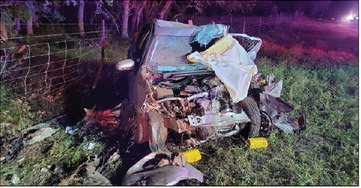
Kim Brasher, 55, an Austin teacher and mother of two, was killed in a vehicle crash about 10 p.m. June 8, 2024, in Kendalia.
The victim’s children, Rain Brasher, 34 and sibling Blue Brasher, 24, said they remain disheartened the defendant won’t spend more time behind bars.
“Even though the court case is over, this tragedy lasts a lifetime for our family,” Rain Brasher said.
Deferred adjudication According to testimony during sentencing in late July of this year, eyewitnesses observed Wampler driving erratically on FM 473 and passing in a no-passing zone before his Chevrolet pickup crossed into Brasher’s lane and struck her Toyota Prius head-on, killing her instantly.
Following the crash, Wampler, then 27, declined to submit to a breathalyzer test or field sobriety examination on the advice of his attorney, Gary Trichter, a Houston-based lawyer who specializes in driving- while-intoxicated cases, according to court records.
Wampler testified at his sentencing he was on the phone with Trichter shortly after the collision. Witnesses told the court the defendant never offered any aid to Brasher.
More than two month’s before the July 30 and July 31 sentencing hearing, Wampler pleaded guilty to manslaughter and waived his right to a jury trial, leaving 451st state District Judge Kirsten Cohoon to determine punishment.
The jurist sentenced Wampler to 10 years of probation as part of deferred adjudication.
Deferred adjudication is a type of plea deal with probation that can be handed down by a court if a defendant pleads guilty or no contest to the charge. A judge does not formally find the accused guilty and, if all community supervision conditions set by the bench are met, the court eventually can dismiss the charge.
Wampler was also ordered to complete 500 hours of community service, pay a $10,000 fee and court costs, and submit to drug and alcohol testing.
Under the court’s guidelines, Cohoon directed Wampler to serve 154 days in the Kendall County Jail, or for the duration of the year.
As a condition of probation, Wampler also must report to the county jail each year on June 8 and June 9 — the anniversary dates of the crash — for the next 10 years and serve two days in custody.
Prosecutors Andrew Fields and Steven Belt had sought a long prison sentence, not probation.
“After significant deliberations among the attorneys in our office, and meeting with the family of the victim, the state recommended 15 years in the Texas Department of Criminal Justice for the offense of manslaughter,” Fields said. “Our office believed the facts of this case warranted such punishment. We presented 20 witnesses at sentencing to paint a complete picture of the events that led to the horrific and completely avoidable crash on FM 473 that night.”
Family still reeling
Blue and Rain Brasher said in their view Wampler’s punishment did not reflect the severity of the crime.
Blue Brasher, who was speaking with her mother by phone at the time of the crash, said the decision to grant deferred adjudication in the case left the family heartsick.
“She (judge) has been hard on criminals in the past and respects what the victim wanted,” said the daughter. “So I would just love to ask her, how does that feel if your verdict made the victim’s family feel crushed?”
Bound by ethical codes of judicial conduct, judges traditionally are prohibited from making statements about the outcome of cases outside of proceedings.
Cohoon through an aide offered this statement to the Star: “Thank you for the opportunity to comment. However, I am not permitted to comment on individual cases outside of statements made from the bench in open court with all parties present.”
The statement added, “Court proceedings are open to the public, and anyone interested in observing the work of the 451st Judicial District Court is welcome to attend. It is a privilege to serve this community, and I appreciate the public’s interest in the work of the court.”
The siblings also expressed frustration over what they see as a lack of accountability from Wampler.
According to the Brasher siblings, they eventually received a card from the Wampler family expressing condolences and noting that a $1,000 donation had been made to a charity in Kim Brasher’s memory.
However, Blue Brasher said they never received a message from the defendant acknowledging responsibility for her mother’s death.
“Never once in that card did he say, ‘I am sorry for killing your mom,’ or take any accountability that he was at fault for our loss,” she said.
However, when Wampler took the stand during the sentencing hearing July 31, he did express his regrets for the death of Kim Brasher.
The Brasher family said there was an insurance settlement but added no amount of money can replace the hole left in their lives by their mother’s demise.
The original allegation The siblings also question whether all evidence was fully considered in the case.
According to court records, authorities originally announced Wampler would be charged with intoxication manslaughter. But on May 18 of this year, Wampler entered a guilty plea to manslaughter after a Kendall County grand jury found insufficient evidence to proceed with the intoxication-related charge, according to court records.
A toxicology report obtained through an open records request showed the presence of tetrahydrocannabinol, the psychoactive component of marijuana, traced to Wampler.
However, Texas law does not have a “per se” law that establishes a specific THC concentration constituting legal intoxication for drivers, unlike surrounding states such as Oklahoma, which would have found Wampler impaired.
Prosecutors also made a note of the toxicology report.
“The second page of the toxicology report has a detailed explanation of the three different findings,” Fields said. “Those findings are why the ingestion of THC was included in the indictment as one of the allegations of recklessness.”
The Brasher offspring also objected to arguments made in defense of Wampler suggesting the crash could have happened to anyone.
“I would never do something like this,” Blue Brasher said. “And if he was really sober, that makes it worse. … This was a violent decision. I feel concerned when people say it was an accident that could happen to anyone, because then I want them off the roads as well.”
When reached by the Star about Wampler’s case, Trichter declined to comment.



Comment
Comments