

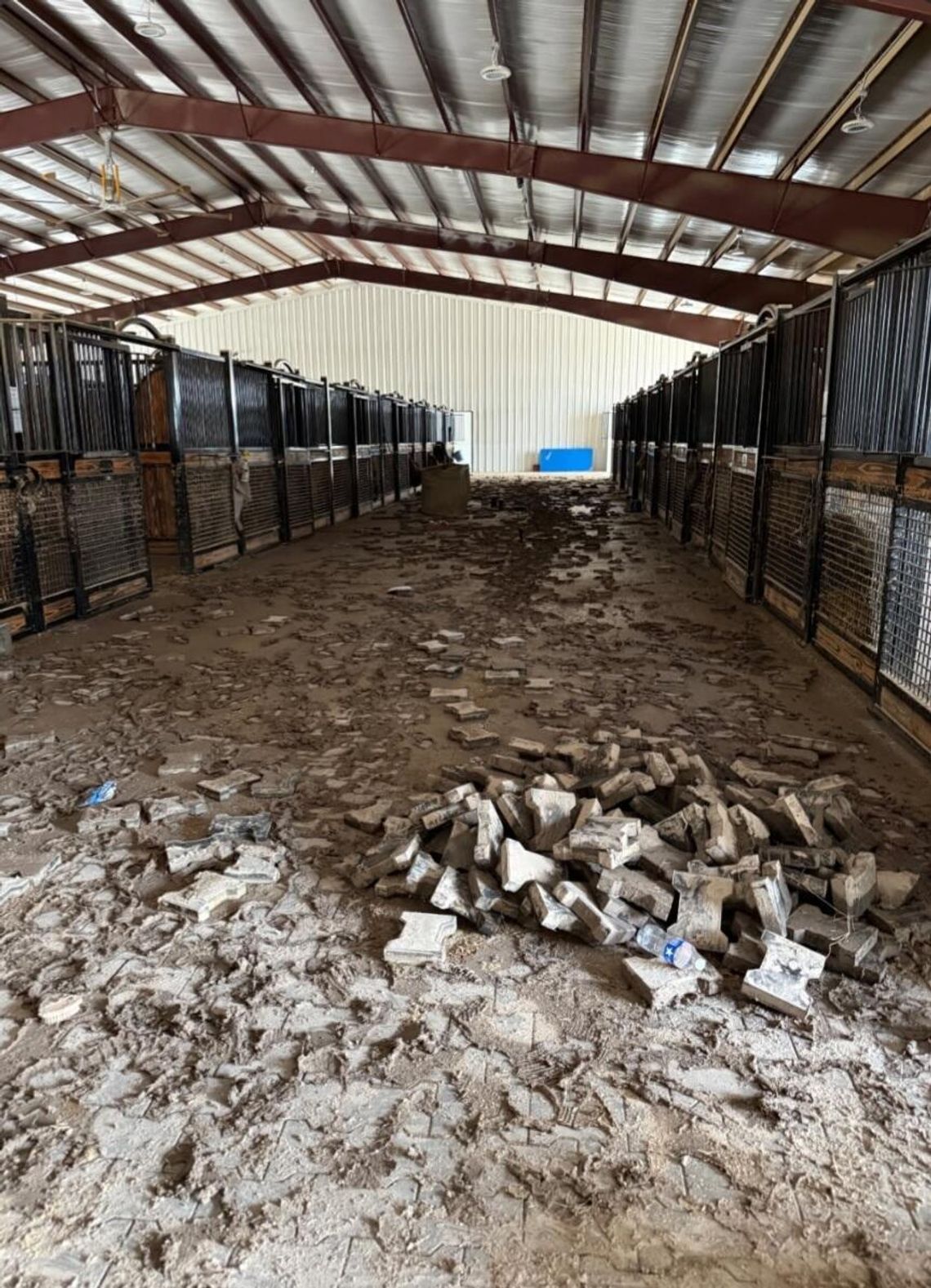
"Fortunately, the water never got to a dangerous level for the horses.” — Ben Wolff, Corrival Ranch
Cleanup from the July deluge will take a long time at Corrival Ranch, but things could have turned out much worse if so many folks hadn’t lent a hand to safely evacuate 120 horses, the co-owner said.
Looking back on the crisis that started July 16 when torrential rains inundated the Hill Country and caused heavy flooding along Sisterdale Road, Ben Wolff — who operates the equestrian facility with his wife, Julie — said the coordinated efforts of ranch staff, volunteers, first responders and disaster-response organizations helped save the day.
"The water came up fast, but without the current you saw in some other areas," he said. "That was a blessing because it allowed rescue teams to get into the barns and begin moving horses as soon as the water went down."
Every horse survived without injury, he added.
Volunteers said things looked bleak at first at the ranch, a 57-acre premiere quarter horse breeding and boarding facility, as well as an equine rehabilitation center, located north of Boerne at 1106 Sisterdale Road.
As floodwaters rapidly rose, access to the ranch was cut off, preventing emergency vehicles from reaching the property.
Staffers worked to move horses from low-lying barns to higher ground before outside assistance arrived.
E.J. Dennis, with Rancher Navy, said his rescue organization responded after volunteer firefighters were unable to reach the site because of the deluge.
"The staff at the ranch were left to their own devices to try and get their horses out of the stables and barns that were in the floodplain as the water was rising," Dennis said. "We got the horses out of the stables and barns and onto higher ground."
According to Wolff, the operation ultimately involved relocating 120 equines. He added the biggest challenge involved coordinating the evacuation of the herd animals under rapidly changing conditions.
As water levels rose and the speed of the current increased, Wolff said the decision was made to temporarily halt the removal to keep volunteers and staff safe.
"Fortunately, the water never got to a dangerous level for the horses," Wolff said. "They're accustomed to water and can swim, so they stayed calm and didn't panic."
Dennis said once floodwaters receded enough to allow trailers onto the property, volunteers quickly moved the animals.
"It was a mix of the local community, the people who own the horses, and their friends and family along with our response team," Dennis said. "We were able to get the … horses loaded up and relocated to another facility where they could continue to be monitored and cared for."
Despite the successful evacuation, Wolff said this year's flooding caused significantly more damage than the catastrophic rains that struck the area during the July Fourth 2025 weekend.
"Last year we had very little damage and actually served as a flood-response center," Wolff said. "This year was completely different."
Initial forecasts mid-July this year suggested a less severe flood event, but conditions deteriorated rapidly. Wolff estimated the nearby Guadalupe River rose 32 feet in less than an hour, inundating barns that had remained untouched during the previous crisis.
Although the floodwaters rapidly swelled, Wolff said the relatively slow-moving current prevented even greater destruction.
The receding water, however, left behind thick mud, debris and extensive damage across the facility.
Cleanup efforts began almost immediately, with dozens of volunteers arriving daily to help restore the property.
Since July 18, Wolff said 50 to 60 helpers have worked at the ranch each day, mucking out stalls, removing water-damaged drywall and clearing debris to allow demolition and rebuilding before mold could spread.
Many of those volunteers received assistance from Corrival Ranch during recovery from the 2025 flood, which claimed 139 lives across the region.
"We housed hundreds of public safety personnel and volunteers during last year's flood," Wolff said. "When we needed help this time, people came back from Houston, Dallas, Lubbock and elsewhere. It really showed how communities take care of each other."
Wolff also credited the Sisterdale Volunteer Fire Department for continuous support during the disaster by relaying critical information and aid.
The ranch operator believes the greatest obstacle during the emergency was the loss of real-time river data.
According to Wolff, the National Oceanic and Atmospheric Administration’s river gauges stopped transmitting the morning of the flood, forcing responders to rely on reports from public safety officials rather than live river measurements.
"We had a plan," Wolff said. "The problem was that without real-time data, we only had about an hour before the water arrived. When you're trying to move more than 100 horses, accurate information is critical to making the right decisions."



Comment
Comments